Building and Environment, 138, 53-62 , Elsevier). (KGU)
Environment|구충완
The effects of indoor plants and artificial windows in an underground environment
2018International Journals
Research AreaEnvironment
Professor구충완
AuthorsKim, J., Cha, S., Koo, C., and Tang, SK
Publication Year2018
Journal (Volume, Issue, Pages)Building and Environment, 138, 53-62 , Elsevier). (KGU)
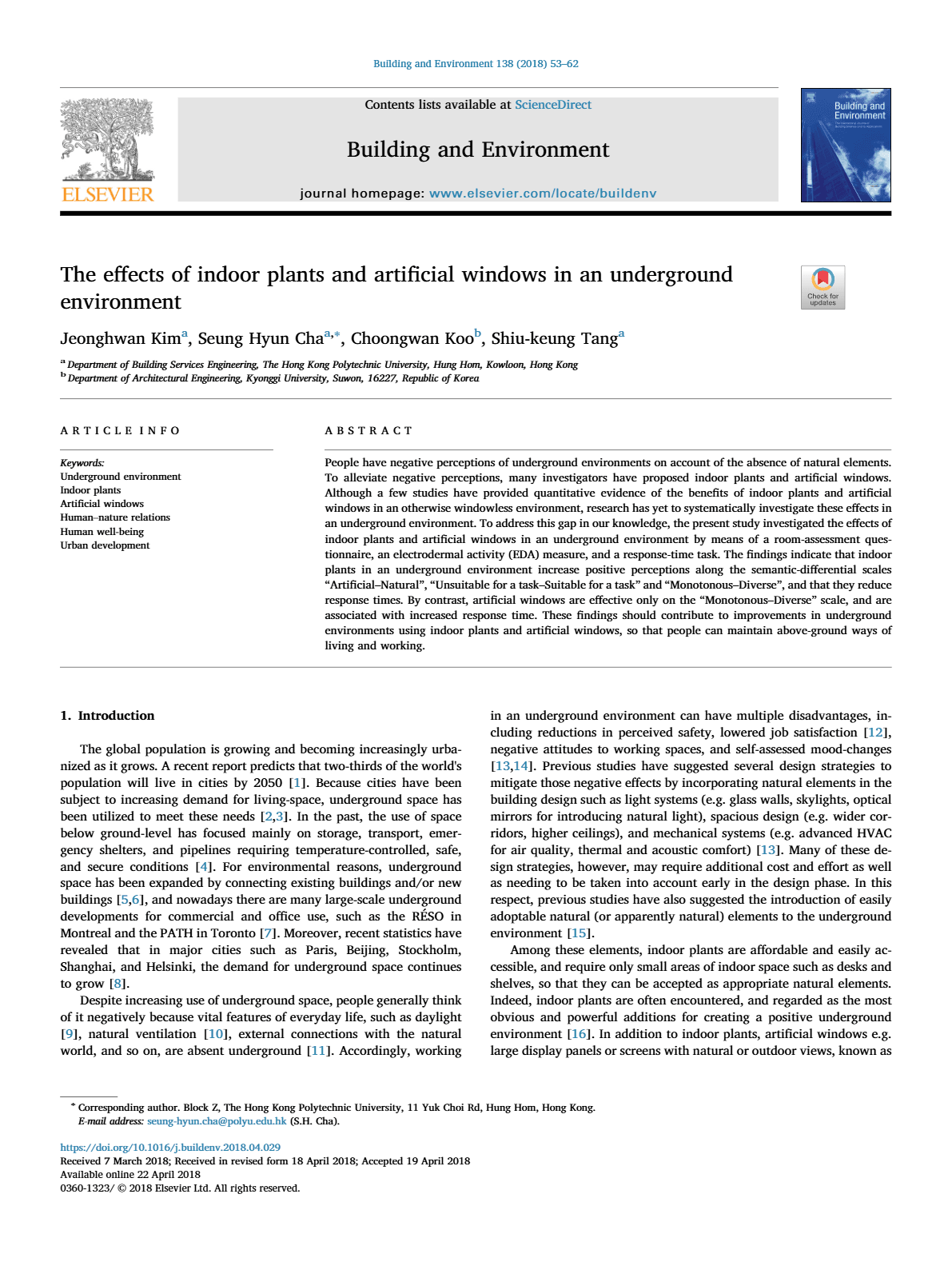
AbstractPeople have negative perceptions of underground environments on account of the absence of natural elements. To alleviate negative perceptions, many investigators have proposed indoor plants and artificial windows. Although a few studies have provided quantitative evidence of the benefits of indoor plants and artificial windows in an otherwise windowless environment, research has yet to systematically investigate these effects in an underground environment. To address this gap in our knowledge, the present study investigated the effects of indoor plants and artificial windows in an underground environment by means of a room-assessment questionnaire, an electrodermal activity (EDA) measure, and a response-time task. The findings indicate that indoor plants in an underground environment increase positive perceptions along the semantic-differential scales “Artificial–Natural”, “Unsuitable for a task–Suitable for a task” and “Monotonous–Diverse”, and that they reduce response times. By contrast, artificial windows are effective only on the “Monotonous–Diverse” scale, and are associated with increased response time. These findings should contribute to improvements in underground environments using indoor plants and artificial windows, so that people can maintain above-ground ways of living and working.
Underground EnvironmentIndoor PlantsArtificial WindowsHuman–nature RelationsWell-beingUrban Development
PrevAn integrated model for estimating the techno-economic performance of the distributed solar generation system on building façades: Focused on energy demand and supplyNextImproving the prediction performance of the finite element model for estimating the technical performance of the distributed generation of solar power system in a building façade