Science of the Total Environment, 659, 1100-1114
Environment|구충완
Multi-criteria decision support system of the photovoltaic and solar thermal energy systems using the multi-objective optimization algorithm
2019International Journals
Research AreaEnvironment
Professor구충완
AuthorsKim, J., Hong, T., Jeong, J., Koo, C., Jeong, K., and Lee, M
Publication Year2019
Journal (Volume, Issue, Pages)Science of the Total Environment, 659, 1100-1114
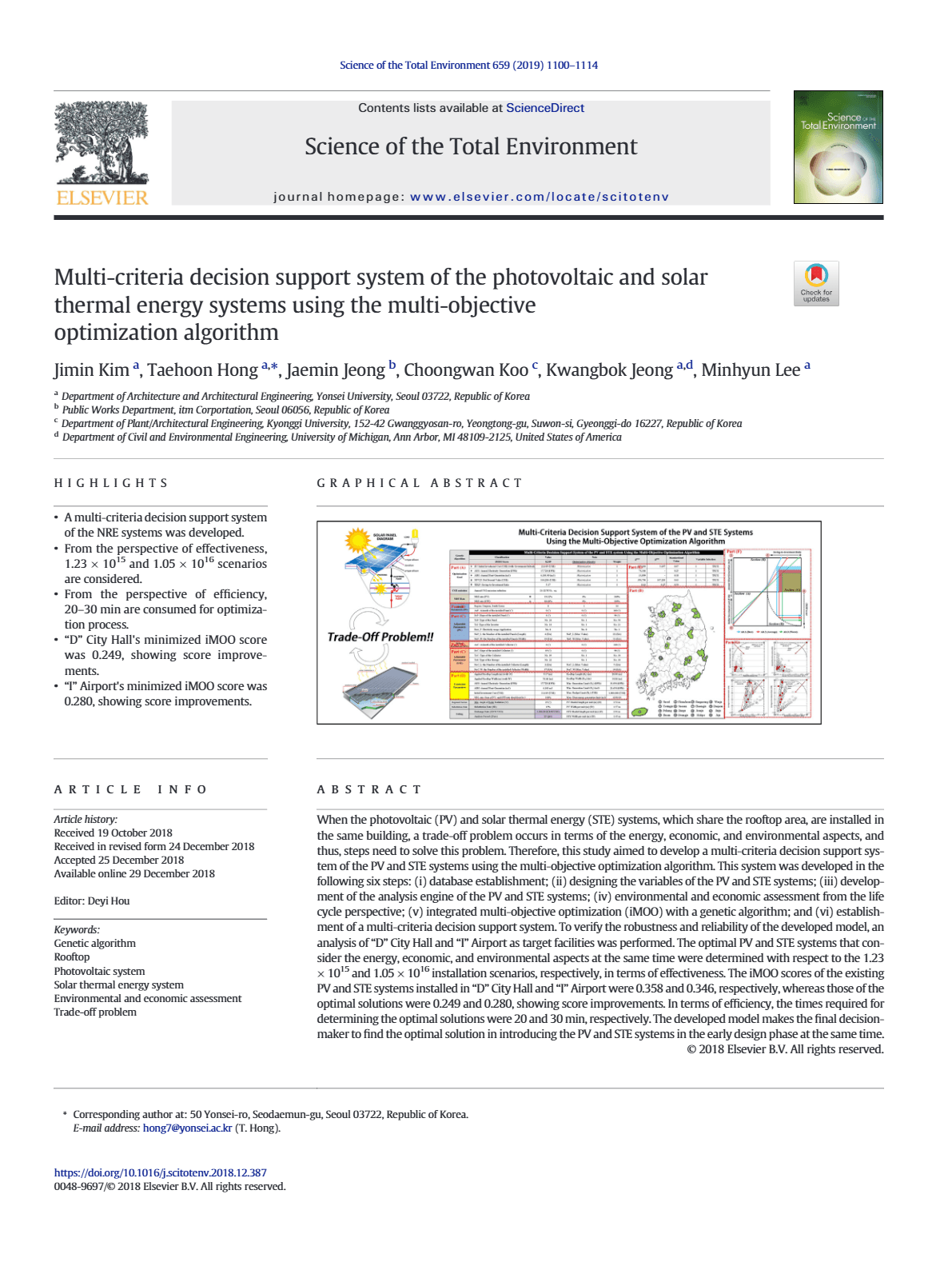
AbstractWhen the photovoltaic (PV) and solar thermal energy (STE) systems, which share the rooftop area, are installed in the same building, a trade-off problem occurs in terms of the energy, economic, and environmental aspects, and thus, steps need to solve this problem. Therefore, this study aimed to develop a multi-criteria decision support system of the PV and STE systems using the multi-objective optimization algorithm. This system was developed in the following six steps: (i) database establishment; (ii) designing the variables of the PV and STE systems; (iii) development of the analysis engine of the PV and STE systems; (iv) environmental and economic assessment from the life cycle perspective; (v) integrated multi-objective optimization (iMOO) with a genetic algorithm; and (vi) establishment of a multi-criteria decision support system. To verify the robustness and reliability of the developed model, an analysis of “D” City Hall and “I” Airport as target facilities was performed. The optimal PV and STE systems that consider the energy, economic, and environmental aspects at the same time were determined with respect to the 1.23 × 10¹⁵ and 1.05 × 10¹⁶ installation scenarios, respectively, in terms of effectiveness. The iMOO scores of the existing PV and STE systems installed in “D” City Hall and “I” Airport were 0.358 and 0.346, respectively, whereas those of the optimal solutions were 0.249 and 0.280, showing score improvements. In terms of efficiency, the times required for determining the optimal solutions were 20 and 30 min, respectively. The developed model makes the final decision-maker to find the optimal solution in introducing the PV and STE systems in the early design phase at the same time.
Genetic AlgorithmRooftopPhotovoltaic SystemSolar Thermal Energy SystemEnvironmental and Economic AssessmentTrade-Off Problem