Sustainable Cities and Society, 119, 106085
Health|구충완
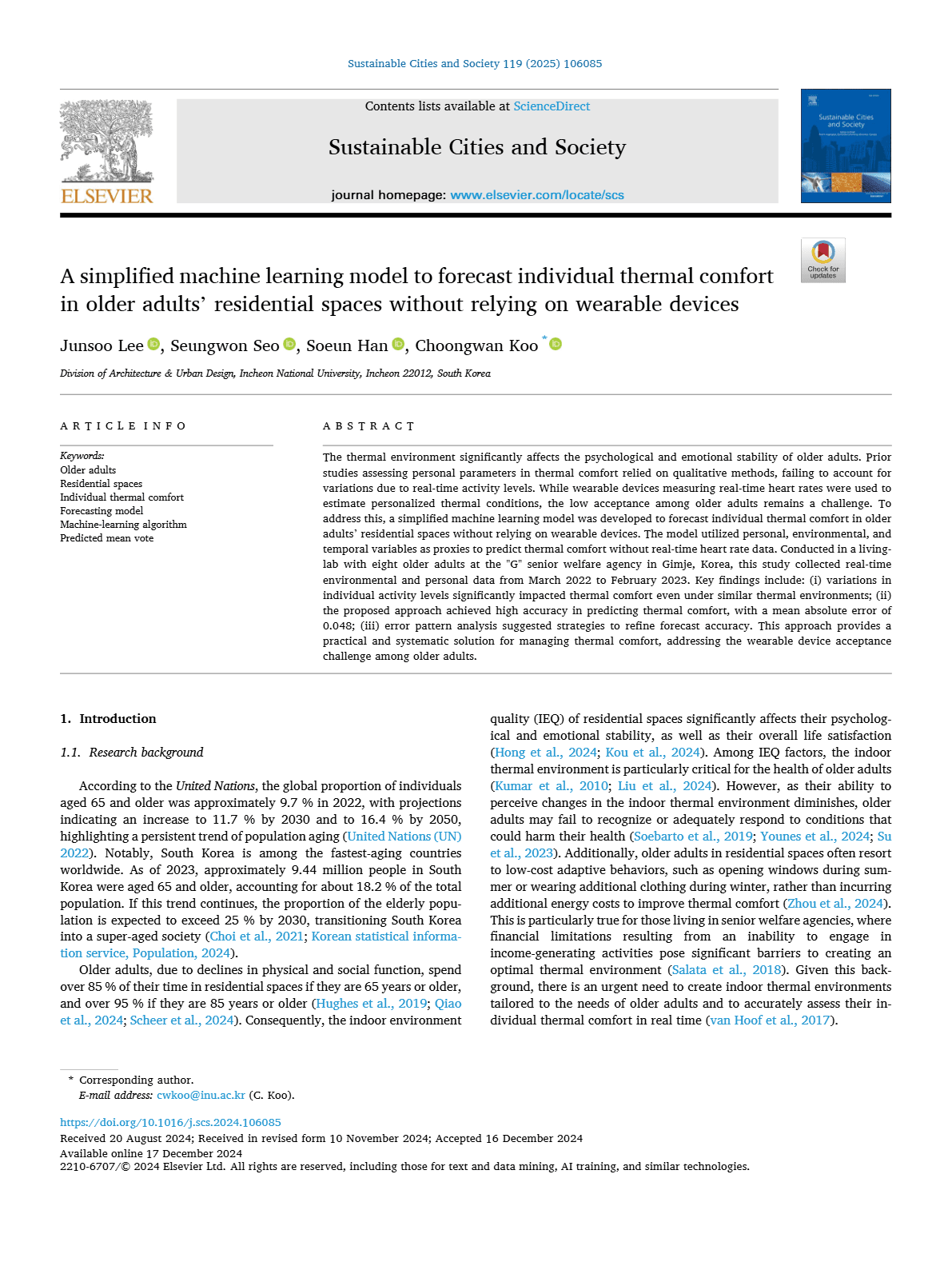
A simplified machine learning model to forecast individual thermal comfort in older adults’ residential spaces without relying on wearable devices
2025International Journals
Research AreaHealth
Professor구충완
AuthorsLee, J., Seo, S., Han, S., and Koo, C. (Corresponding Author)
Publication Year2025
Journal (Volume, Issue, Pages)Sustainable Cities and Society, 119, 106085
AbstractThe thermal environment significantly affects the psychological and emotional stability of older adults. Prior studies assessing personal parameters in thermal comfort relied on qualitative methods, failing to account for variations due to real-time activity levels. While wearable devices measuring real-time heart rates were used to estimate personalized thermal conditions, the low acceptance among older adults remains a challenge. To address this, a simplified machine learning model was developed to forecast individual thermal comfort in older adults’ residential spaces without relying on wearable devices. The model utilized personal, environmental, and temporal variables as proxies to predict thermal comfort without real-time heart rate data. Conducted in a livinglab with eight older adults at the "G" senior welfare agency in Gimje, Korea, this study collected real-time environmental and personal data from March 2022 to February 2023. Key findings include: (i) variations in individual activity levels significantly impacted thermal comfort even under similar thermal environments; (ii) the proposed approach achieved high accuracy in predicting thermal comfort, with a mean absolute error of 0.048; (iii) error pattern analysis suggested strategies to refine forecast accuracy. This approach provides a practical and systematic solution for managing thermal comfort, addressing the wearable device acceptance challenge among older adults.
Older AdultsResidential SpacesIndividual Thermal ComfortForecasting ModelMachine-Learning AlgorithmPredicted Mean Vote